Bound in Biblical Binders’ Waste
CLAVIUS, Christoph.
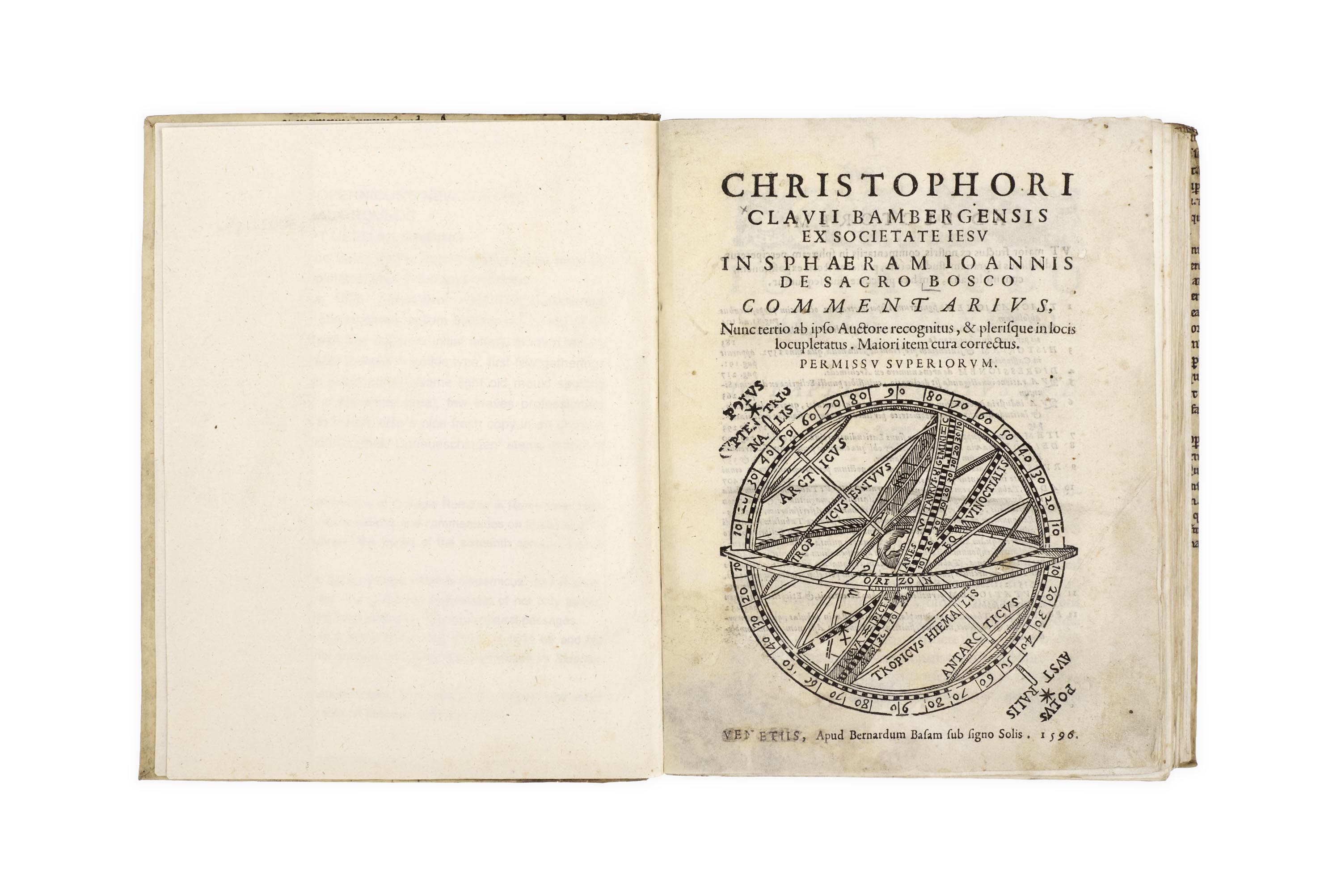
In Sphaeram Ioannis de Sacro Bosco commentarius. Nunc tertio ab ipso auctore recognitus, et plerisque in locis locupletatus. Maiori item cura correctus. Venice, Bernardo Basa, 1596.
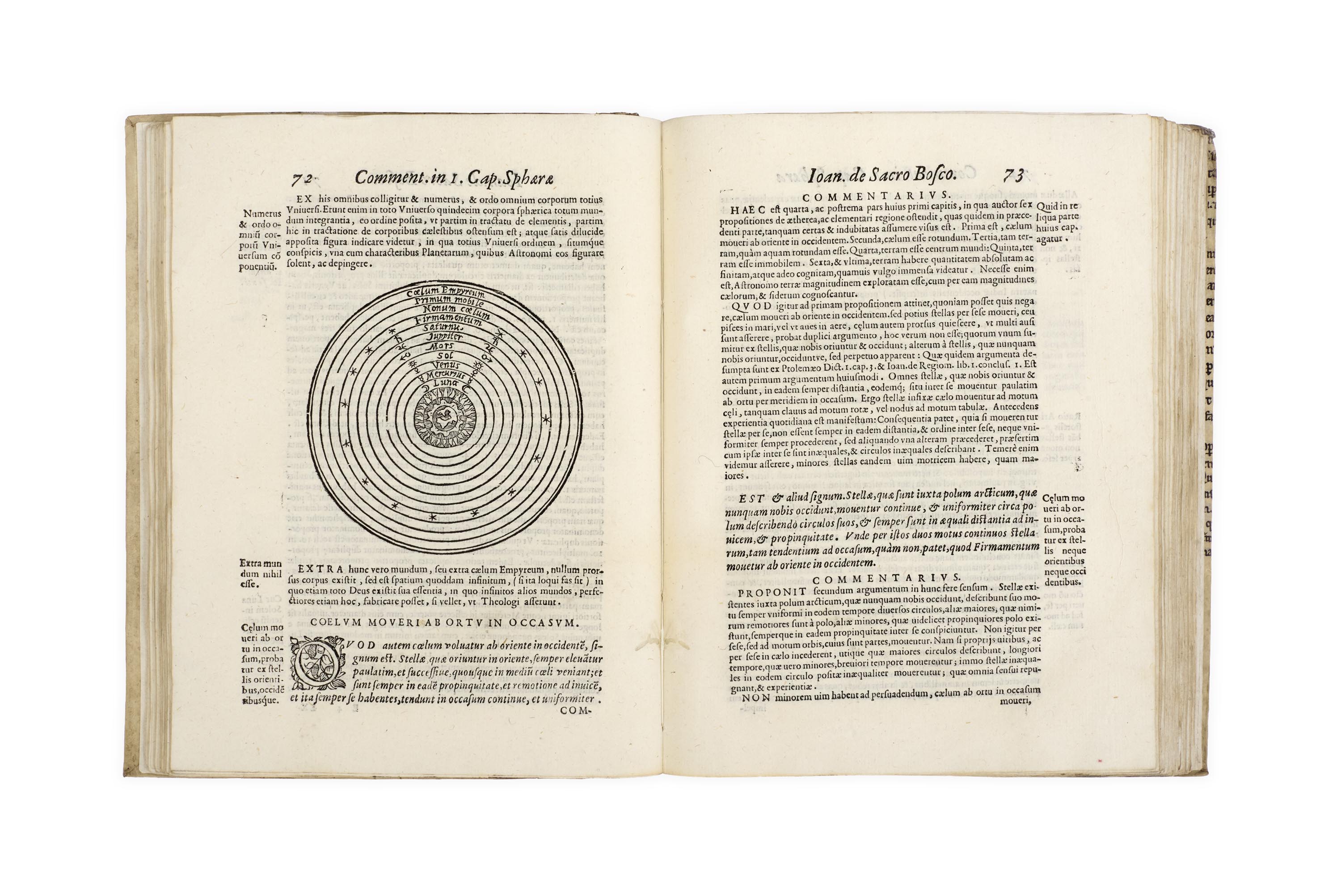
4to, pp. [xxx], [ii, blank], 483, [1], large woodcut astrolabe on title, and with numerous woodcut figures and diagrams in text; first few gatherings carefully washed, some light old mould-spotting still visible in lower margins of first few leaves, lower inner corner of title neatly repaired (without loss of text), but a good copy in contemporary German vellum re-using a bifolium from a twelfth-century glossed Bible manuscript, remains of ties; slightly soiled and rubbed, spine and endpapers renewed.
Added to your basket:
In Sphaeram Ioannis de Sacro Bosco commentarius. Nunc tertio ab ipso auctore recognitus, et plerisque in locis locupletatus. Maiori item cura correctus.
Scarce Venetian edition of Clavius’s influential commentary on Sacrobosco, first published in 1570, bound using a leaf from a sophisticated twelfth-century glossed biblical manuscript.
Clavius’s commentary, which occupies the majority of the text, sought to bring the Ptolemaic astronomy of Sacrobosco up to date with later sixteenth-century astronomy, and it quickly became the standard Jesuit textbook on astronomy, going through several editions. Clavius taught a course in astronomy at the Collegio Romano for which this commentary served as the text.
Clavius (1537–1612), a Jesuit from Bamberg, was a friend of Galileo but never wavered in his geocentric beliefs. In fact, in the 1581 edition of this work, he condemned Copernicanism as physically absurd, although elsewhere he speaks with praise of Copernicus. When Galileo published the Siderius nuncius in 1610, Clavius was one of his principal defenders. He had a telescope constructed and was able to verify Galileo’s observations of the satellites of Jupiter and the shape of Saturn.
The present edition bears a dedication addressed to the Veronese writer Giovanni Giacomo Toniali by the Venetian publisher and typographer Giovanni Battista Ciotti.
Manuscript waste:
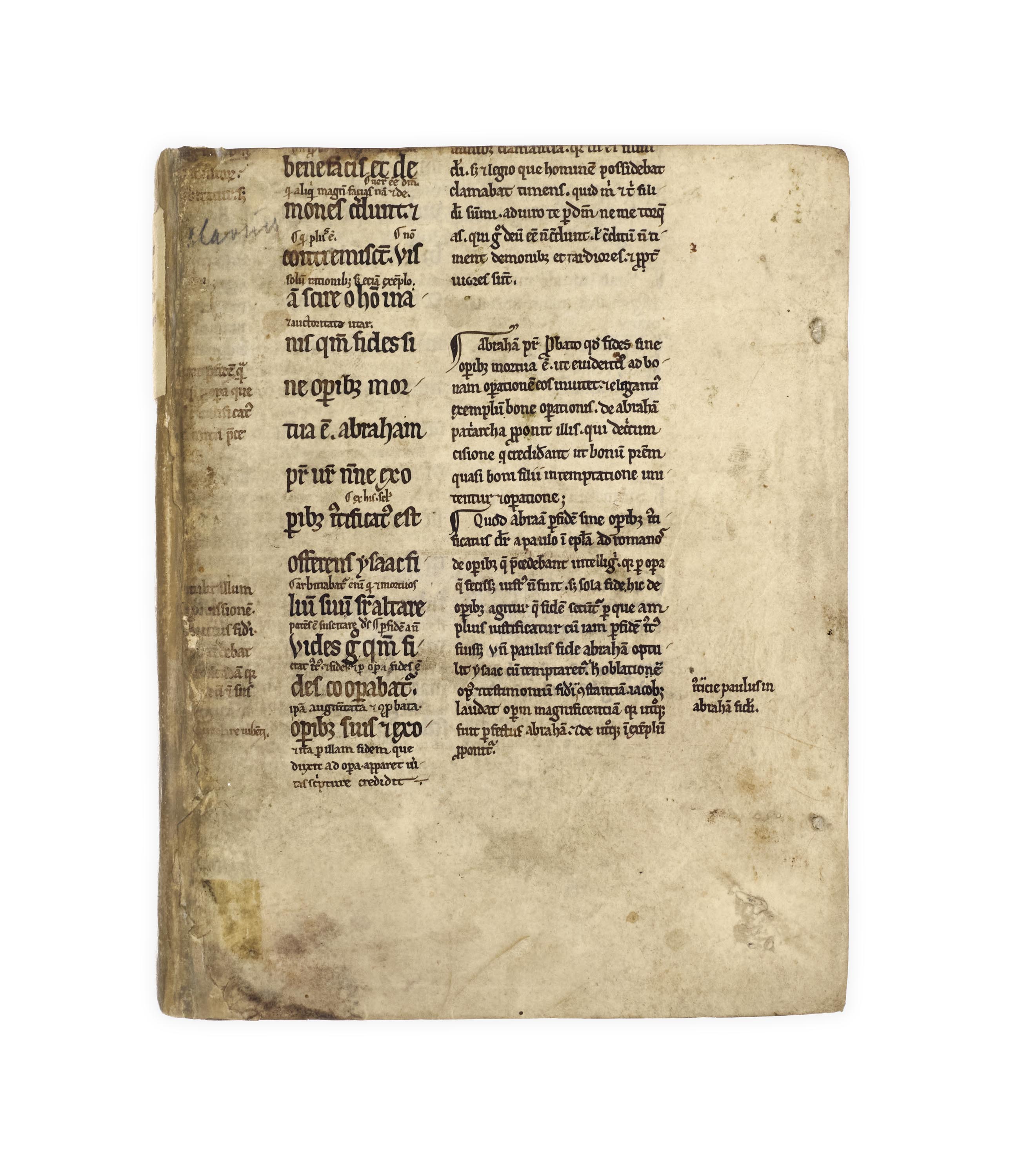
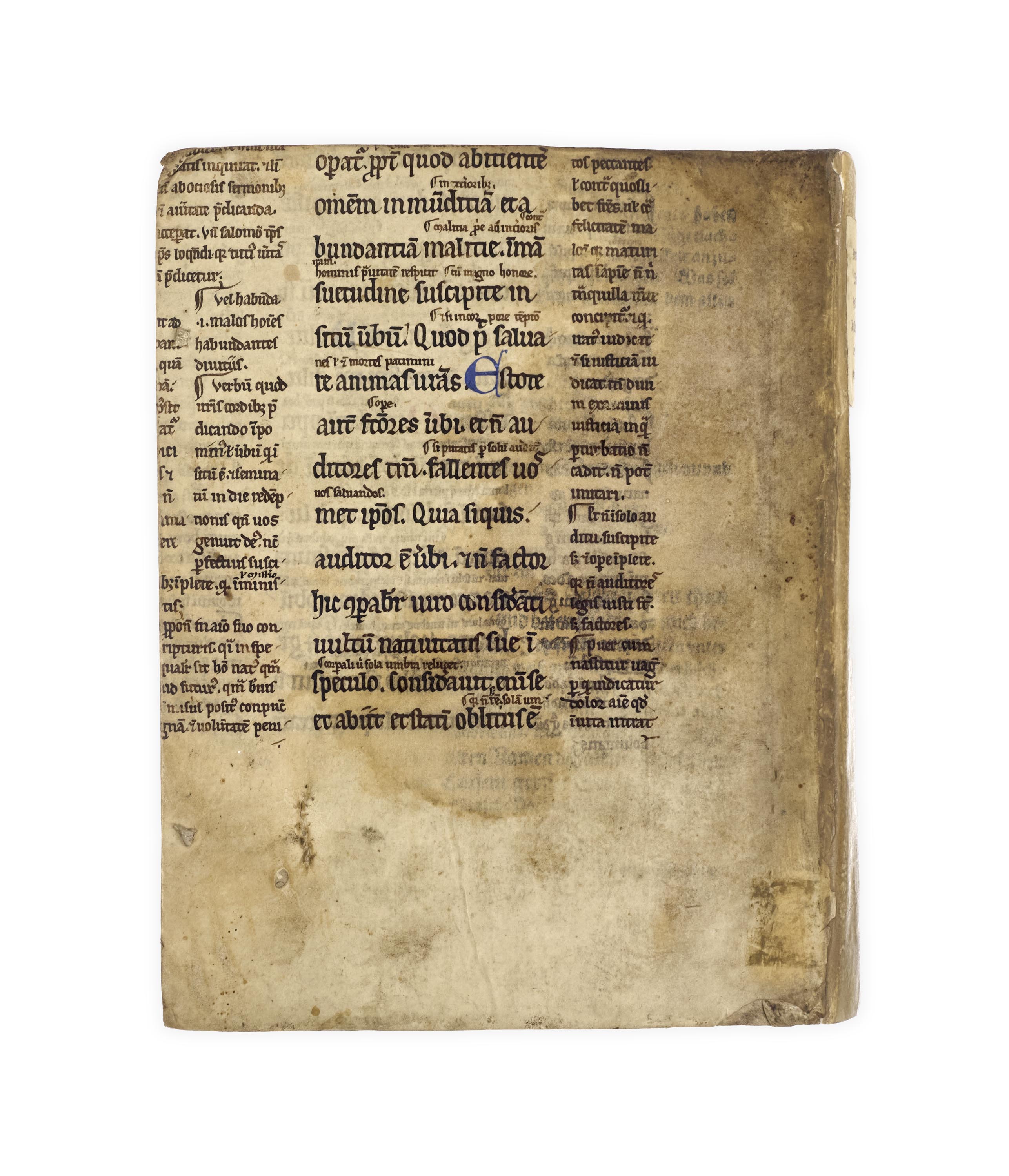
The binding preserves a large fragment of a bifolium (leaves not consecutive, single leaf measures c. 206 x 160 mm not including turn-ins) from a glossed Bible, produced in Northern France (probably Paris) in the third quarter of twelfth century, containing a Glossed Epistle of James, in Latin, James 1,19–24 and 2,19–22; central column of Bible text written in a very good late romanesque hand, 14 lines remaining, the marginal gloss written in an equally fine but smaller script and the interlinear gloss in a yet smaller script, dark brown ink, ruled in plummet to accommodate the central text and gloss, a single initial in blue, a scribal note in one margin correcting an omission caused by homeoteleuton; slightly rubbed and soiled, section missing where spine of book renewed, but generally in very good condition.
The marginal and interlinear commentary comes from the Glossa Ordinaria which was the standard medieval commentary on the Bible. It consists of explanatory notes extracted from patristic and medieval writers, first gathered and arranged by the masters of the cathedral school of Laon in the late eleventh and early twelfth centuries, especially Anselm of Laon (d. 1117), his brother Ralph (d. 1133), and their pupils including Gilbert the Universal (d. 1134).
The work of compiling the gloss proceeded book by book, and the whole Bible had been completed by the middle of the twelfth century. For details of the production of glossed Bibles, where the commentary was ingeniously arranged around the biblical text, see de Hamel, Glossed books of the Bible and the origins of the Paris book trade, Woodbridge, 1984. See also Light, The Bible in the twelfth century, Cambridge, Mass., p. 79 ff. Visible on the present fragment are two different ‘tie-marks’, aids to the reader found at the ends of glosses which would have indicated where the relevant gloss continued on the next page.
Provenance: from the Donaueschingen library, with small stamp at foot of title verso.
EDIT16 CNCE 12683; USTC 822874; Sommervogel II 1212. This edition not in Adams and not found in Library Hub.