Extremely Rare Manual for English Priests
[GUIDO DE MONTE ROCHEN.]
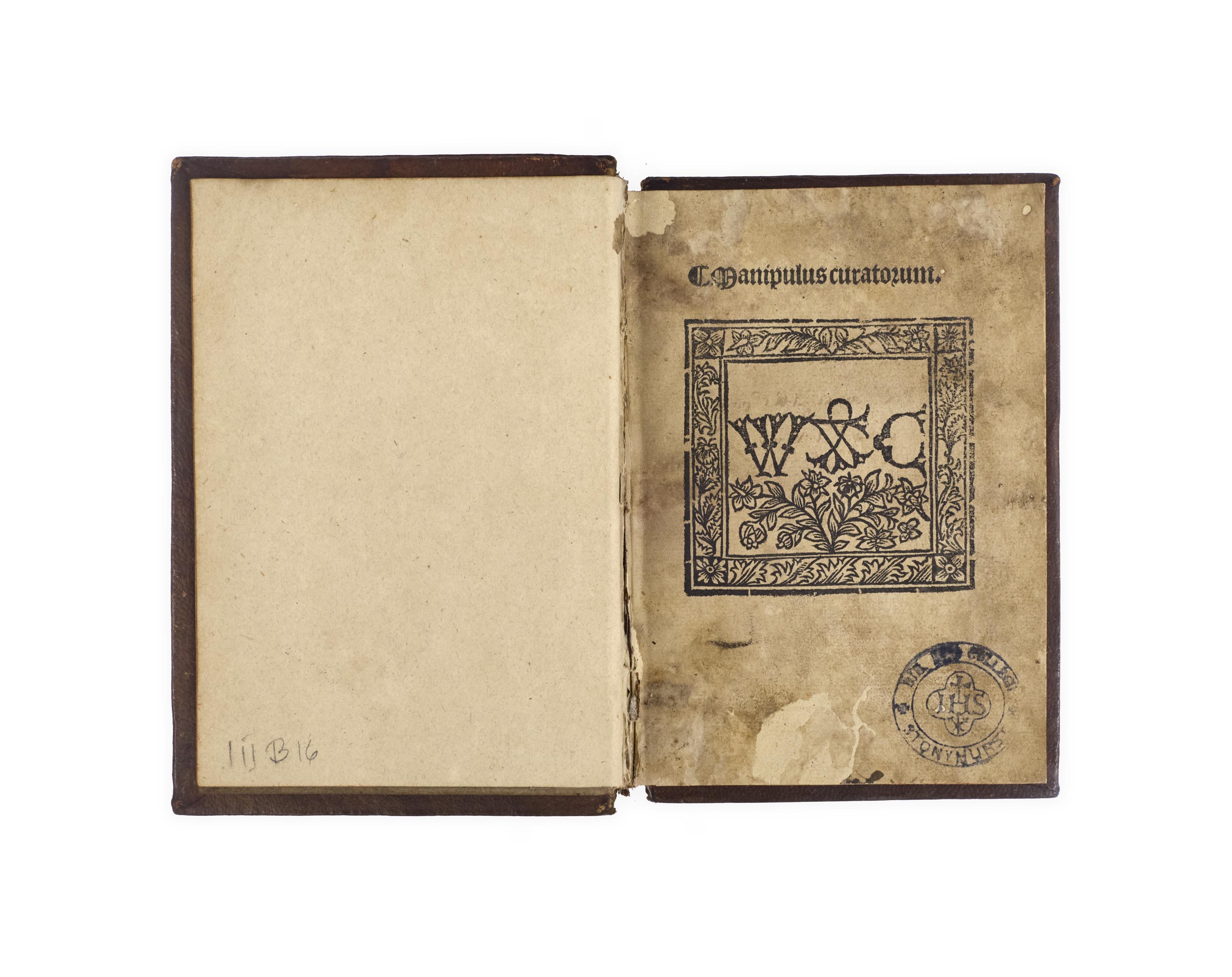
Manipulus curatorum. [(Colophon:) London, Wynkyn de Worde, 22 April 1502.]
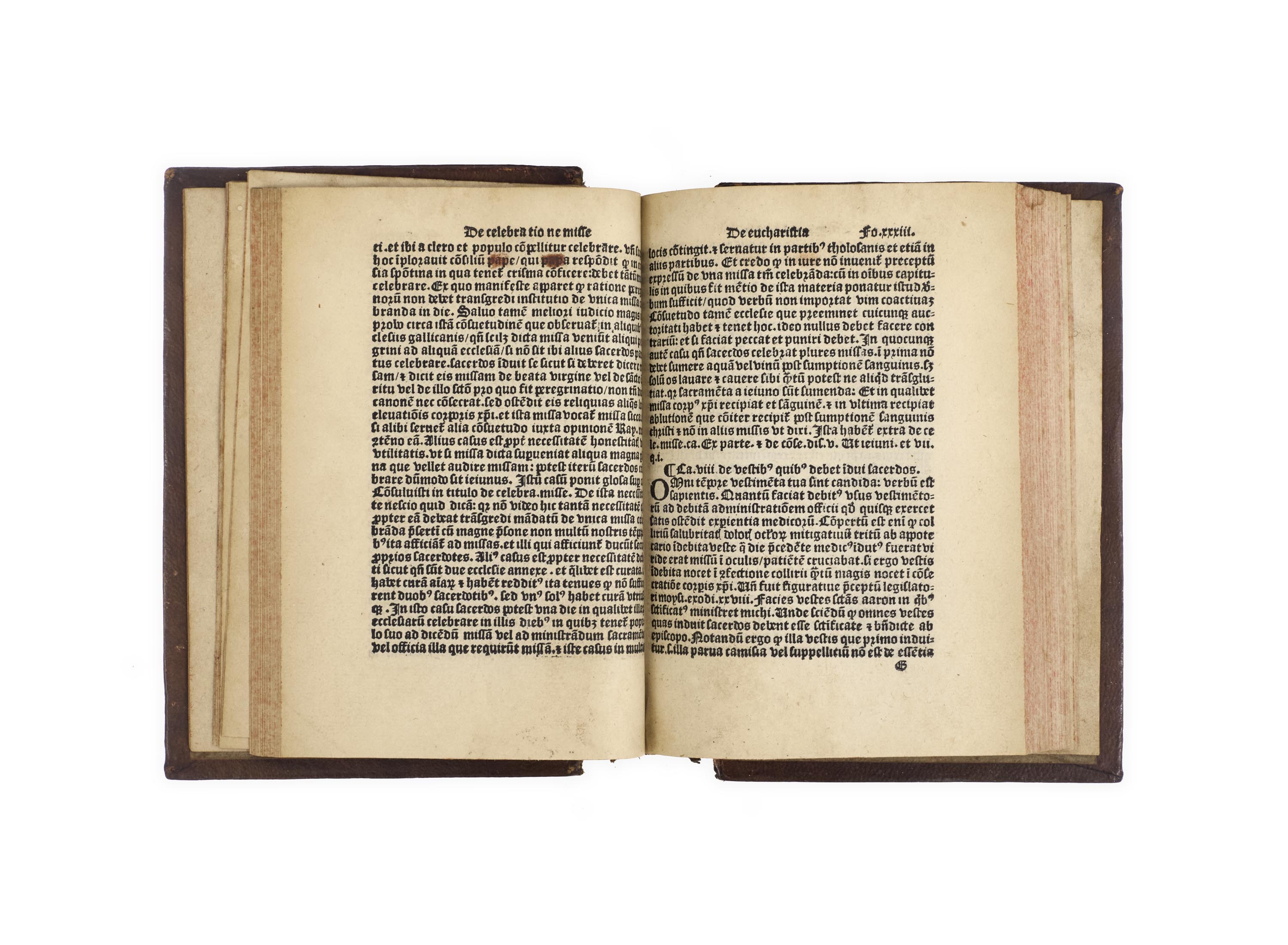
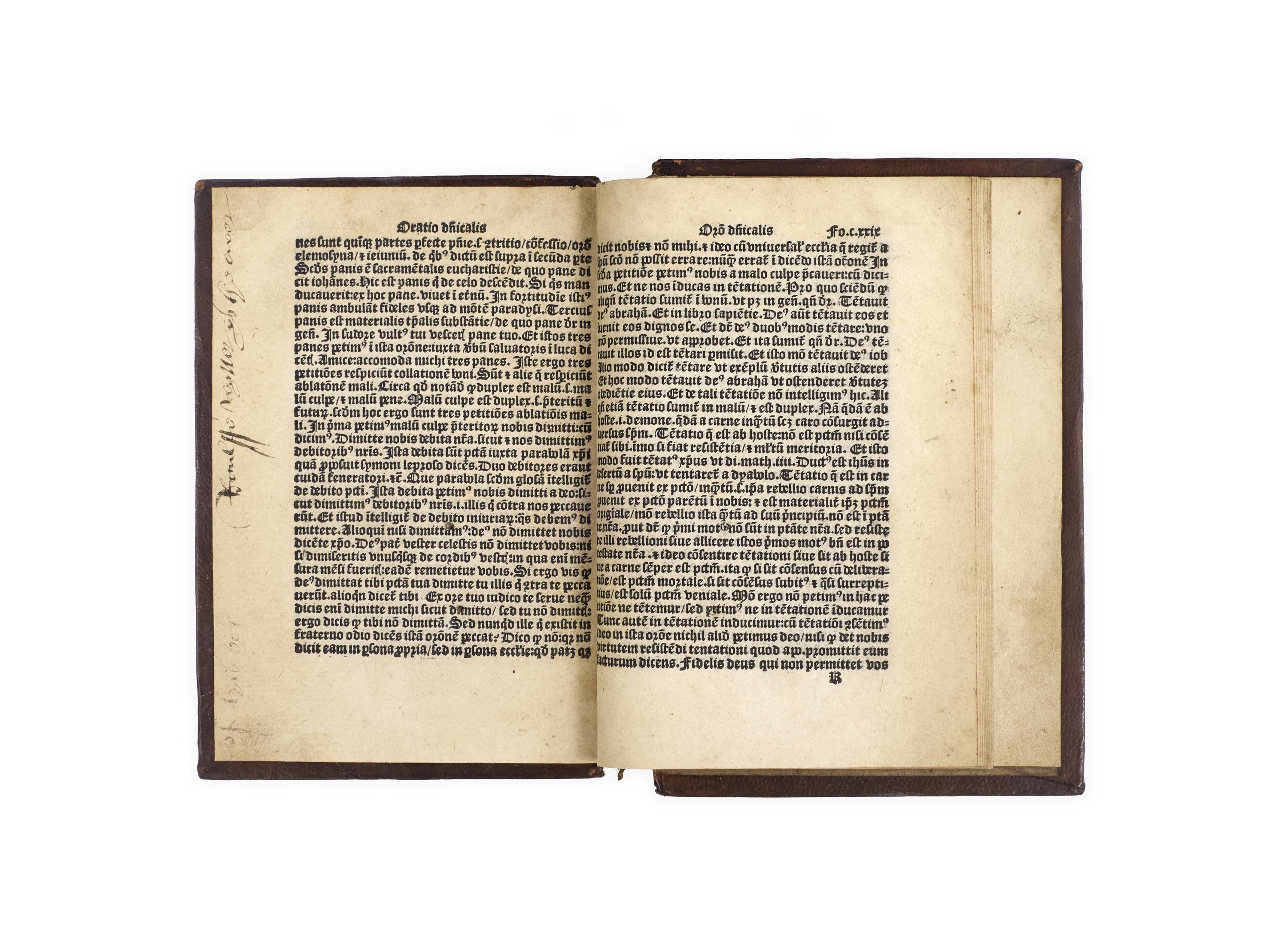
8vo, ff. cxxxiv, [4]; A–Q8 R18, quire E missigned ‘G’ as in BL copy but foliation continuous; gothic letter, Wynkyn’s Caxton device (McKerrow 10b) to title; title dusty and laid down with some loss to edges, repairs to head and tail of A2–7 with loss to headlines of A2 and a few others shaved, closed tear to A2 affecting a dozen words, tear to inner margin of A3 with a handful of words lost, minor losses to head of C1–D2 not affecting text, small wormtrack to quire A affecting a few letters on 2 ff., small wormtrack to last 3 quires affecting a couple of words per page, light damp-stains to head throughout and a few other minor blemishes; else a very good, crisp copy in nineteenth-century sheep over wooden boards; neatly rejointed, endcaps and -bands lost; contemporary ownership inscription to f. cxxviiiv (‘of this bo[ke] Raulffe Wyller ys the ower’), offsetting from an early inscription to f. lviv, ‘Pope’ struck out in red on ff. xxxiiv and xxxixr, pencil manicule to f. xcviiiv, marks in red crayon to a couple of leaves, ink stamp of Stonyhurst College to title and rear flyleaf.
First Wynkyn de Worde edition of this immensely popular medieval handbook for priests, one of only four complete copies known.
Composed in the 1330s by Guido de Monte Rochen (also Monte Rocherii or Roterio), the Manipulus curatorum met the growing need for pastoral guidance and the training of priests in the wake of the Fourth Lateran Council (1215). Aimed at simple curates and written in a suitably unadorned style, the work is in three parts: the first on six of the seven sacraments; the second on penance (the remaining sacrament and a matter of particular complexity for parish priests); and the third on catechesis. ‘Although Guido’s manual had much in common with contemporary pastoralia, it stood out from the pack by adapting and simplifying the genre’s basic features to serve its audience more effectively. The Handbook is long enough to be comprehensive, but short enough to be truly useful’ (Thayer and Lualdi, p. xxiv).
‘More than 250 manuscript copies of the Handbook for Curates are still extant, but it truly came into its own with the advent of printing. Between circa 1468 and 1501, some 122 editions of the Handbook rolled off European presses both big and small, making it the eleventh most printed title in the period’ (ibid., pp. xiii–iv). Only the Inquisition in the Catholic world and the Reformation in the Protestant put an end to its widespread use, as witnessed by the anti-papal deletions in our copy.
The present edition was the third to be printed in England, preceded by two from the press of Richard Pynson (1498 and 1500). All English editions (of which there are seven, the last printed in 1517) are very rare, with copies often found imperfect. Of the present edition, only three other complete copies are recorded by ESTC (BL, Glasgow, Rylands). Two imperfect copies are at Stonyhurst and Illinois, and Bodley holds a made-up copy of the 1517 edition with two quires supplied from the 1502. They are also very scarce in commerce – no complete copies of the present edition appear in auction records, and of the others we can trace only the York Minster–Doheny copy of the 1509 edition (last sold in 2024, $9500), the Stonyhurst copy of the 1500 edition (sold Sotheby’s 2003, £6600), and another copy of the same (sold Sotheby’s 1983, £1078) in the last century.
ESTC S111275; STC 12472. See Anne T. Thayer and Katherine J. Lualdi, introduction to Guido of Monte Rochen, Handbook for Curates (2011).