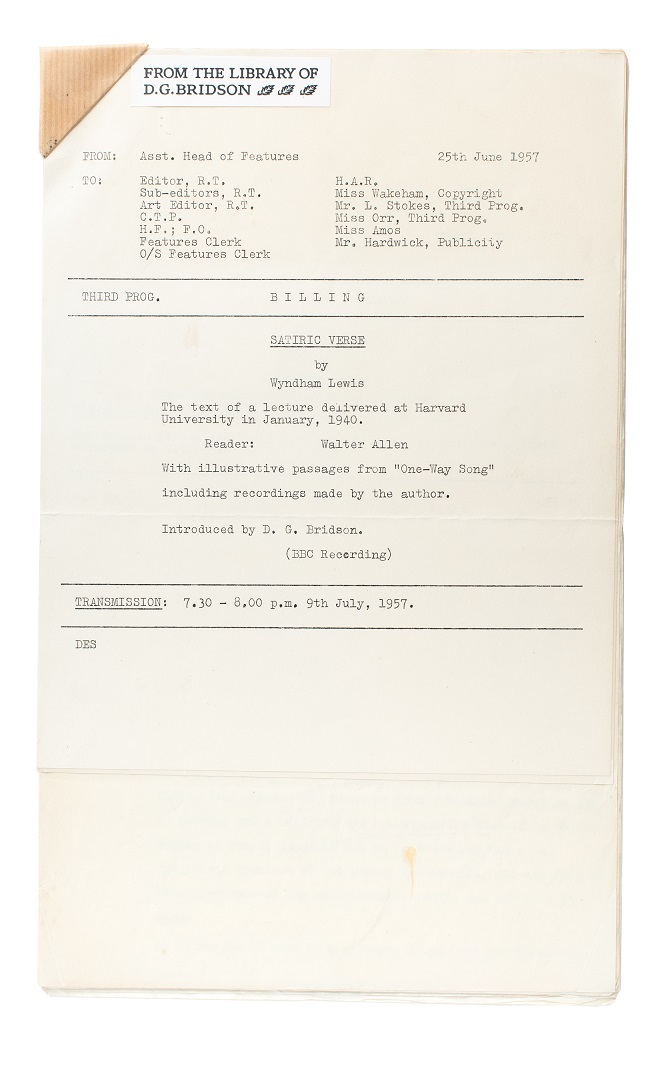
Corrected Broadcast Script
LEWIS, Wyndham, and D. G. BRIDSON.
‘Satiric Verse … The Text of a Lecture delivered at Harvard University in January, 1940’. Transmitted 9 July and 23 August 1957.
Typescript, folio, ff. [3, billing notes and text of intro and outro, with corrections in blue pen], 29 [carbon copy typescript with corrections in blue pen]; ff. 29 [typescript in carbon copy, with cuts indicated in red pencil, Bridson’s closing remarks rewritten in pencil], [1, broadcast notes, details of fees paid, etc]; stapled in upper left corner, folded, book label of the radio producer D. G. Bridson to first leaf.
£1,200
US $1,587 €1,399
If you wish to order more than one copy of this publication please make an enquiry. Add to basket Make an enquiry
Added to your basket:
‘Satiric Verse … The Text of a Lecture delivered at Harvard University in January, 1940’.
Typescript for broadcast of a lecture delivered by Wyndham Lewis.
The poet, journalist and radio producer Douglas Geoffrey Bridson was responsible for over 800 broadcasts in his career at the BBC, 1933–1969, which culminated in his appointment as Programme Editor for Arts, Sciences, and Documentaries in the mid-1960s, when he was known as ‘the cultural boss of the BBC’. His tireless and democratic promotion of modern British and American literature on the airwaves led to correspondence and then friendship with nearly all the major literary figures of his day, but most notably with Wyndham Lewis, T.S. Eliot, Hugh MacDiarmuid, Ezra Pound, and Langston Hughes, many of whose works he brought to a wider audience through his radio productions. He published three of his own collections of poetry, a memoir of his years at the BBC, Prospero and Ariel (1971), and a study of the politics of Wyndham Lewis, The Filibuster (1972); his archive of papers and correspondence is now at the Lilly Library.
Bridson first met with Lewis in person in 1950, when he contacted Lewis to adapt The Childermass (1928), Lewis’s radical work of theological science fiction, for radio. On the back of strong reviews for the adaptation, Bridson managed to secure BBC sponsorship for Lewis to finish the long-awaited trilogy which The Childermass had begun, on the condition that the resulting work, The Human Age, would premiere on radio before it appeared in print. ‘Critical reaction … was immediate and enthusiastic, many of the critics particularly commenting on the novelty of such a major work by a major writer making its first appearance over the air’.
Bridson went on to produce radio-adaptations of Tarr and The Revenge for Love. All the dramatizations ‘were the joint work of Wyndham Lewis and D.G. Bridson. In each case, first draft was written by Bridson which indicated the kind of additional narration of dialogue which would be required to bridge the gaps created by necessary cutting and condensation of the original work.’ (Bridson ‘Checklist’, in Pound & Grover).
Bridson and Lewis spoke for the last time in January 1957 after a second broadcast of Tarr (first aired in July 1956), Lewis asking the same questions as he had after the first – was the actor who played Bertha really German (no), and was Anastasya really drunk (no). Lewis died on 7 March, and Bridson was one of only 30 guests at his funeral on 13 March – ‘depressingly flat and uninspriring … Most of those that one would have expected to attend … were conspicuously absent’.
Although a recording of Lewis reading from ‘One Way Song’ was made at Harvard in 1940, the lecture that accompanied it, ‘Satiric Verse’, was not then recorded. For the 1957 broadcast it was read by Walter Allen ‘from Lewis’s own manuscript notes’. Several other sections were read by Stephen Murray. Bridson produced, and provided an introduction and some linking remarks between sections.
‘It is a great pity that so little survives from this reading by Wyndham Lewis. As he says himself, it was undertaken when he was not in very good voice, and the recording was obviously dashed off in a rather perfunctory way. Even so, it preserves the drive and speed and panache of the Enemy in a way that posterity may be happy about’.
Bridson ‘Checklist’ H10, in Pound & Grover.