Legal Elopement
An Irregular Marriage ‘Certificate’ From Gretna Green
[PASLEY, Joseph].
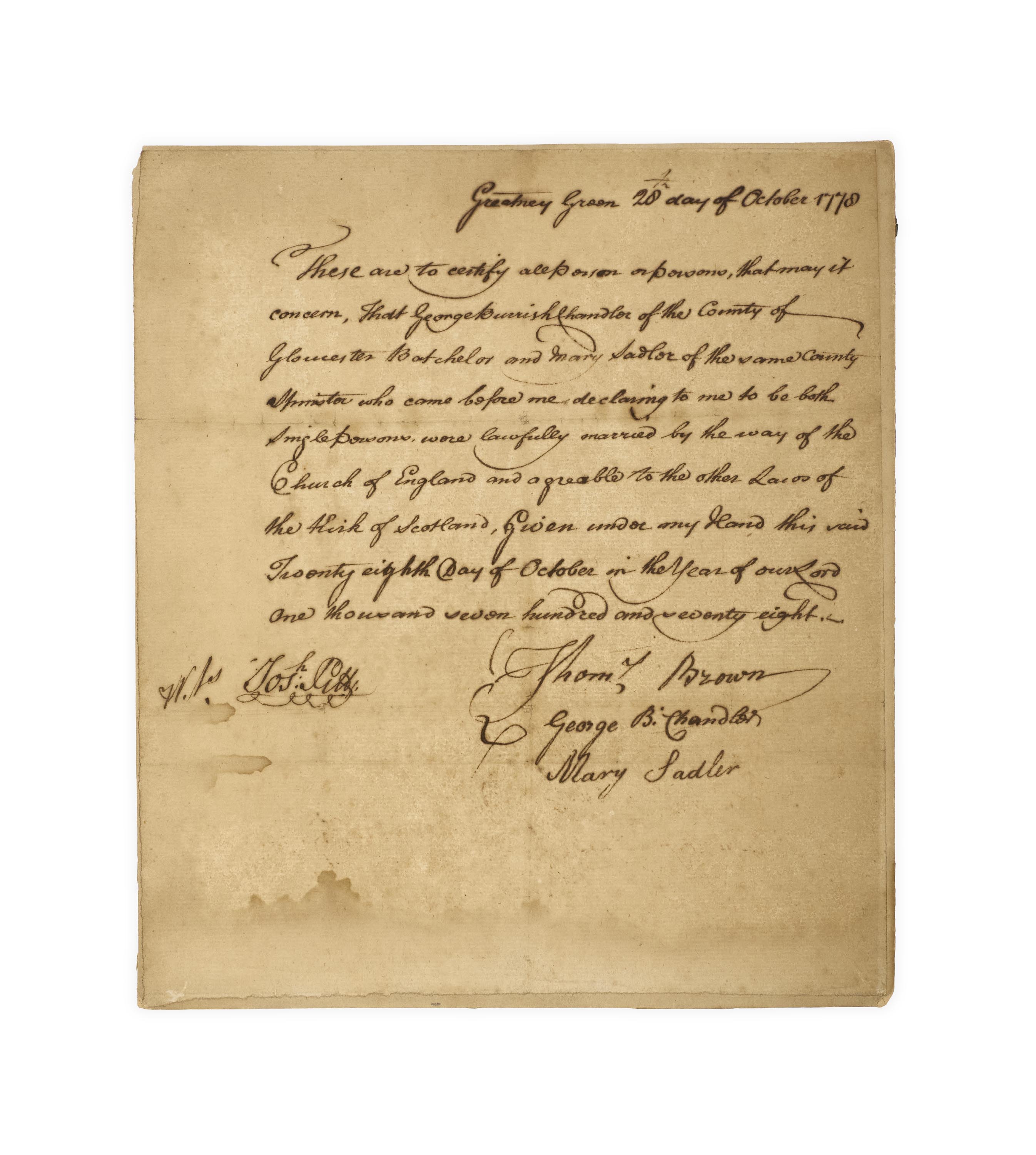
Manuscript marriage certificate for George Burrish Chandler and Mary Sadler, of Gloucestershire, signed by them and by ‘Thoms Brown’, and witnessed by ‘Josh Pitt’. ‘Greatney Green’, 28 October, 1778.
Manuscript on paper, 4to, p. [1]; laid down on card and consequently somewhat browned, creased where folded, old damp-stain at foot.
Added to your basket:
Manuscript marriage certificate for George Burrish Chandler and Mary Sadler, of Gloucestershire, signed by them and by ‘Thoms Brown’, and witnessed by ‘Josh Pitt’.
A very rare early Gretna Green marriage certificate (the second earliest we can trace), between a pregnant seventeen-year-old and her twenty-six-year old lover, likely signed by the infamous ‘anvil priest’ Joseph Pasley under the pseudonym ‘Thomas Brown’.
By Lord Hardwicke’s Marriage Act of 1754, England tightened restrictions on marriages to allow a parent to veto a union if the participants were under the age of 21, and required intention to marry to be declared publicly in advance. Scotland by contrast allowed boys of fourteen and girls of twelve to marry without parental consent, and permitted various forms of ‘irregular’ marriage without an officiating priest, and so became a destination of nuptial pilgrimage for those looking to avoid uncooperative relatives. But it wasn’t until the construction of a toll road passing through the obscure border village of Graitney, later Gretna Green, in the 1770s that the industry had found its capital, and the village’s blacksmiths and inns saw the unions of many thousands of couples into the mid-nineteenth century, from the high-born (for example John Fane, future Earl of Westmoreland, and the heiress Sarah Child), to the desperate and impecunious. Gretna marriages became a leitmotif of Minerva Press novels of the 1780s and 1790s, of sentimental gothics like those of Charlotte Smith, and of the courtship novel – and Scottish elopement plotlines feature in Fanny Burney, Susan Ferrier, and Jane Austen, even if in Pride and Prejudice Lydia and Wickham only declare they have ‘gone to Gretna’ and actually end up in London.
The most famous of the early ‘anvil priests’ (though not in fact operating in a smithy) was Joseph Pasley (d. 1814?). Son of a dissenting minister, Pasley was a tobacconist’s apprentice turned fisherman and smuggler renowned for his physical strength and his copious consumption of brandy. He started as an assistant to another fisherman and anvil priest, Walter Coultard, around 1753, before setting up in competition. These were marriages by declaration, requiring only two witnesses, and no officiating official – registration was voluntary and no certificate required but for form’s sake. Pasley was though happy to oblige and would sign his ‘certificates’ (as a witness only) under a number of pseudonyms including Thomas and John Brown. The second witness here may also be a Pasley pseudonym. Pasley was apparently called to testify in a trial in Bristol in 1794, and subsequently after legal advice he would sign a second time under his own name. The couple would be given a copy of the certificate, and another was retained by Pasley in a brown jug, whose contents he later (c. 1800) destroyed.
Pasley became a celebrity, featured in periodicals and in a long article in Public Characters in 1806. Among other claims there is that he would vary his charges according to the couple’s means, but that he would also sometimes extort an extra payment from the unfortunate would-be bride. The wedding was then conducted in the bedroom of an inn according to a simple formula loosely based on the marriage service, ‘but the Gretna High-Priest … will not furnish a certificate until he has seen the parties in a situation which must be shocking to the delicacy of a well-bred female’. The article also wryly comments on his prodigious memory, Pasley often being able to recollect a wedding conducted many years prior and furnish a certificate in place of one lost, after only being provided with all details and a payment.
According to the present ‘certificate’, when George Burrish Chandler (1752–1822), of Little Witcombe, Gloucestershire, eloped to Scotland with the seventeen-year-old Mary Sadler, of Badgeworth in the same county, she was already pregnant with their first child, who was born in June 1789 but died an infant. Records suggest that they had at least two sons and four daughters that survived infancy and that they ‘married’ again just before George’s death, presumably to regularise the union to prevent any challenge to inheritance.
Inevitably there are no systematic records of early irregular marriages, and only small numbers of eighteenth-century Gretna Green marriage certificates survive, many likely destroyed for the social stigma. In 1934 ‘Claverhouse’ (i.e. Meliora C. Smith) published the only modern account of Irregular Border Marriages, mentioning two certificates of 1776 and 1785 signed by ‘Thomas Brown’ as here, and we can find passing mention of others so signed in The Story of an Irish Sept (1896), dated 1780, and A Georgian Country Parson (2004), but cannot trace their current whereabouts. In terms of identifiable extant examples in public archives, we can trace the following, in chronological order:
1763: BL Add MS 44919 f. 16 (signed John Brown)
1780: West Yorkshire Archive Service WYL230/3847
1780: Shakespeare Birthplace Trust DR 4/149 (signed Joseph Percifield)
1782: Northamptonshire Archives Service W(A) box 1/parcel VI/no. 1 (the Fane–Child marriage, signed John Brown)
1787: BL Add MS 89675 (for Thomas Ring and Sophia Thompson, later friends of John Newton, signed Thomas Brown)
The earliest example above, from 1763, is rough and ready, with abundant misspellings (‘This is to sertifey … lawfoley maried’) and is signed by witnesses but not the parties marrying. Evidently the process became more refined over time – both ours and the other example we have seen (BL Add MS 89675) are in a clear secretarial hand, correctly spelt, and using the same wording, signed at the foot by ‘Tho. Brown’ and the two parties marrying.
See ‘Claverhouse’, i.e. Meliora C. Smith, Irregular Border Marriages (1934).