A Baronetcy for the Governor-General of Bengal
SHORE, John, Sir, Baron Teignmouth.
Letters patent as a baronet, and subsequently as Baron Teignmouth in the Peerage of Ireland. London, 27 October 1792, and Dublin, 38 March 1798.
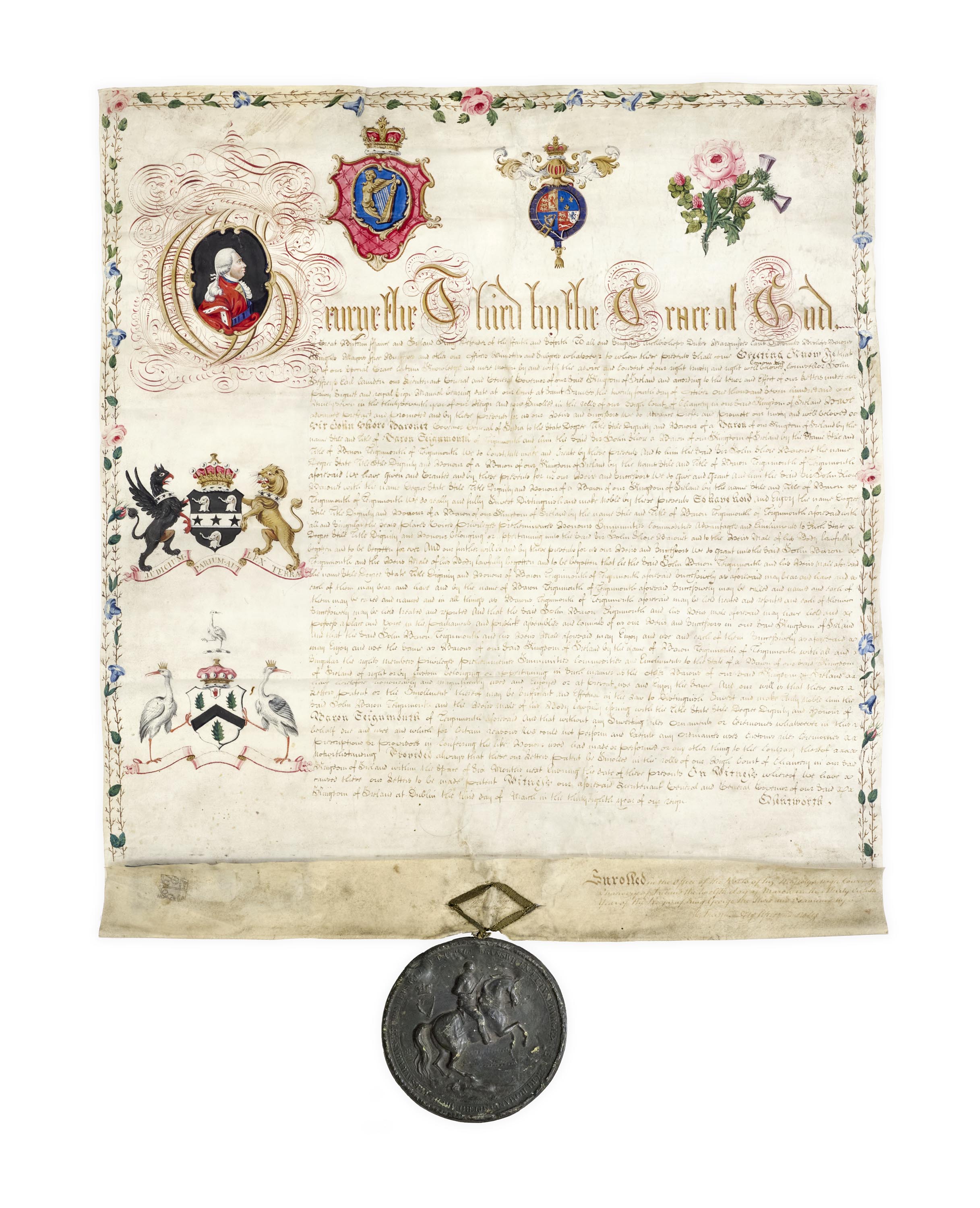
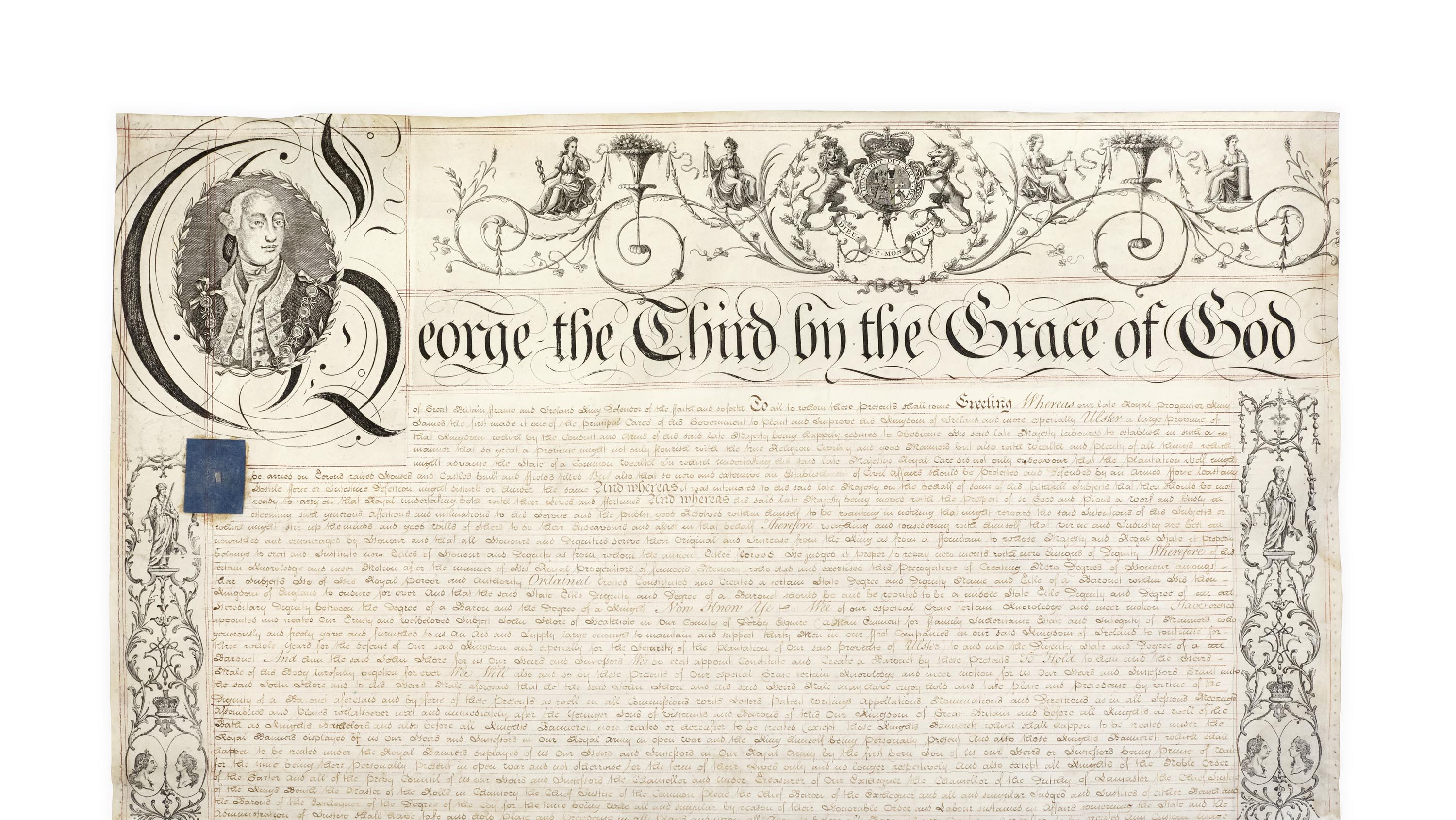
Two vellum documents, 1792: on two membranes c. 620 x 800 mm and c. 600 x 770 mm, the text in brown ink, signed at the foot ‘Yorke’, borders and first line of text (with a profile portrait of George III in the first initial) engraved; fragmentary great seal, note of enrolment by George Harrison, Norroy, on the external face; 1798: one membrane c. 720 x 650 mm, the text in brown ink, signed at the foot ‘Wentworth’; first line of text in red ink and gilt, with a large calligraphic initial featuring a profile portrait of George III, along the head the harp of Ireland, the royal arms and a rose and thistle in colours, on the left side Shore’s arms below and those of John Pratt, Lord Lieutenant of Ireland above, all within a decorative border of flowering vines; note of enrolment at the foot, with the Great Seal of George III in black wax, preserved in a pewter box.
Added to your basket:
Letters patent as a baronet, and subsequently as Baron Teignmouth in the Peerage of Ireland.
Two attractive Georgian letters patent, the first a modest part-printed affair in monochrome, the second a fine illuminated example with an intact Great Seal.
John Shore (1751–1834) was the son of a minor East India Company employee, and first came to India as an EIC writer in 1768, where his facility for languages and political nous saw him rise to a post as a revenue official under Warren Hastings (he was a witness at the trial in 1790), and later to a seat on the Supreme Council of Bengal, where he helped spearhead many of the judicial and financial reforms brought in by Cornwallis. Proficient in Persian, Hindustani, Arabic and Bengali, Shore produced a number of translations of Indian texts including the Yoga Vasistha (Quaritch had a possibly unique manuscript copy of this in 2013). Having apparently refused a baronetcy on grounds of poverty in 1790, he accepted in 1792 when he was appointed Governor-General in succession to Cornwallis. His tenure (1793–1798), which was relatively uneventful, saw a focus on trade rather than militarism, which allowed the growth of French influence and of the military power of the Mahrattas and Tipu Sultan. He did however intervene in the Oudh (Awadh) succession, installing Saadat Ali Khan II in place of the more rebellious Wazir Ali Khan.
For his services in India Shore was made Baron Teignmouth in the Irish Peerage in March 1798, the month he returned from India. Shore never took his seat in the Irish House of Lords, and instead devoted himself to religious and philanthropic measures, becoming the first president of the British and Foreign Bible Society in 1804, and publishing a memoir of his friend Sir William Jones. In later years he was a prominent member of the evangelical Clapham Sect, alongside Zachary Macaulay and William Wilberforce, and published some Considerations on the Praticability, Policy, and Obligation of communicating to the Natives of India the Knowledge of Christianity (1808).