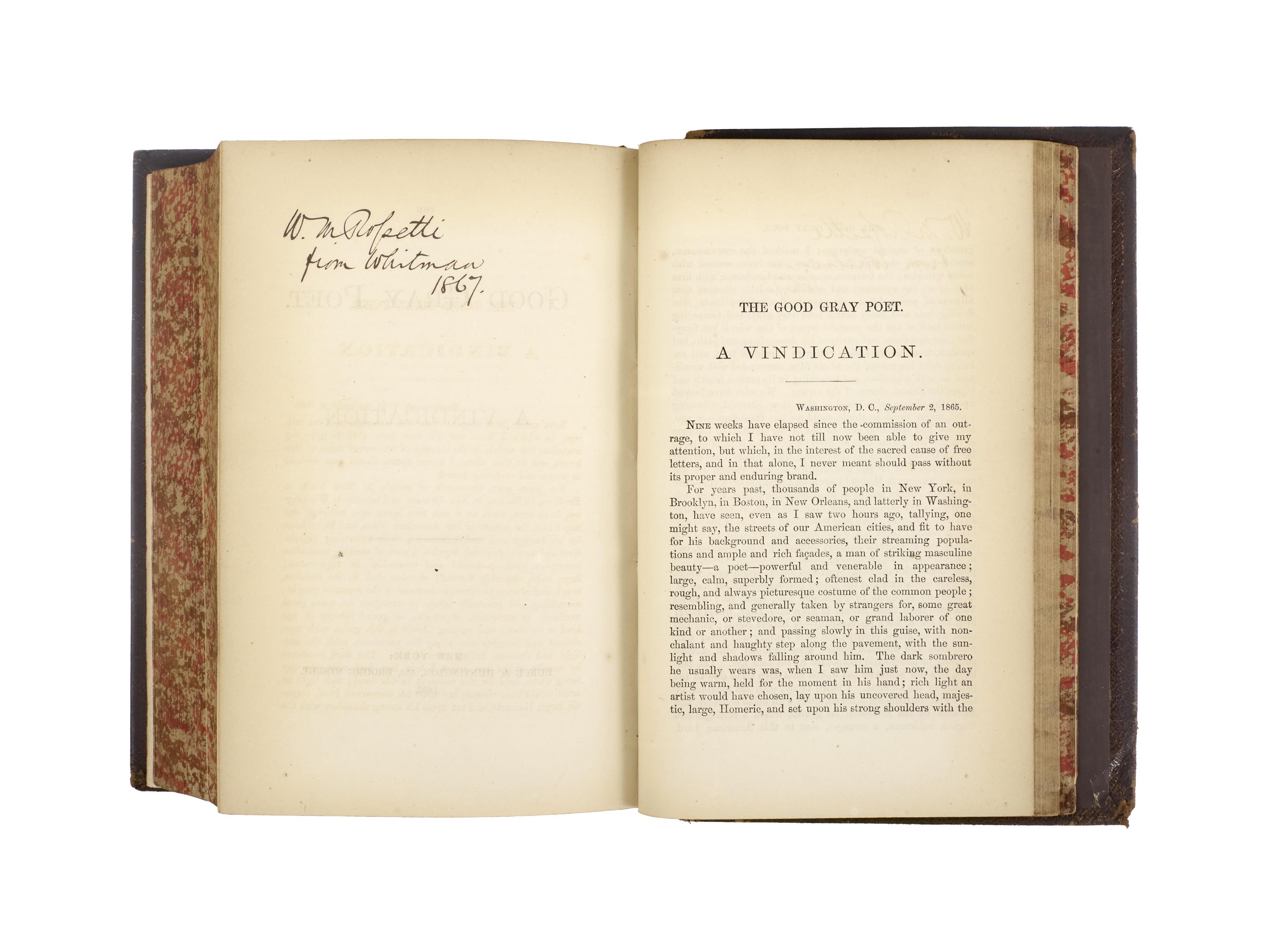
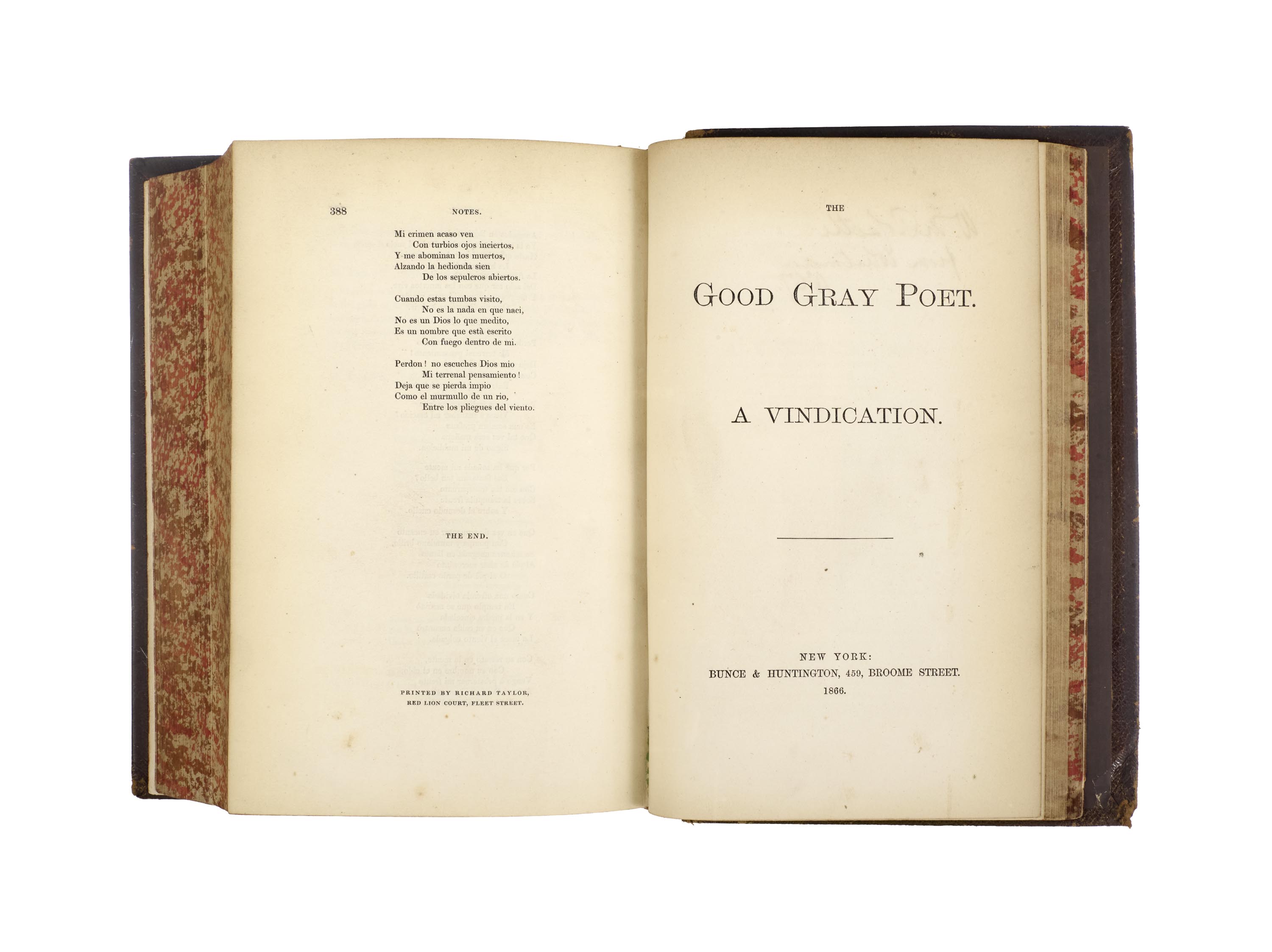
A Presentation Copy From Whitman to His Most Important English Champion
[WHITMAN, Walt.] [O’CONNOR, William Douglas.]
The Good Gray Poet, a Vindication. New York, Bunce and Huntington, 1866.
[bound with three other works.]
8vo, pp. 62; bound third in a thick tract volume along with Campori, Lettere artistiche inedite (Modena, 1866); Kennedy, Modern Poets and Poetry of Spain (London, 1860); and one other; bound together in contemporary green morocco, sunned, edges worn, spine brown and dry, marbled edges; ownership inscriptions to front endpaper of William Michael Rossetti and of his daughter Mary Elizabeth Madox Rossetti (dated 1919).
First edition of the first separately published work on Walt Whitman, inscribed in the recipient’s hand on the title-verso ‘W. M. Rossetti from Whitman / 1867’.
A journalist, editor, photographer and disciple of Whitman, O’Connor had helped procure the poet a position in the Indian Affairs Bureau in 1865. After only a few months in post, on 30 June Whitman was fired as part of a loyalty and morality drive by the Secretary of the Interior, James Harlan, who had found a copy of Leaves of Grass on Whitman’s desk. O’Connor came to Whitman’s defence, securing him another government post in the Attorney General’s office in 1866, and publishing this Vindication, which is both an attack on Harlan and a spirited defence of Whitman. Alongside Whitman’s elegy for Lincoln, ‘Oh Captain! My Captain!’, The Good Gray Poet played a vital role in rehabilitating Whitman’s reputation in both the short and the long term, and the titular moniker was one that stuck.
Across the pond Rossetti was doing his own work in defence of Whitman, publishing a famously supportive review in the London Chronicle on 6 July 1867, followed by an important edition of Whitman’s poems in 1868. It was O’Connor who had suggested John Camden Hotten as Whitman’s London publisher in late 1866; and at one point Whitman had hoped that O’Connor might provide an introduction to Rossetti’s edition.
The Good Gray Poet is very scarce on the market in any form, but we have not been able to trace any other examples presented by Whitman. ‘There has been continuing debate about the possible amount and substance of Whitman’s involvement in this work’, says Myerson. The present copy suggests that it was significant, and that he took some pains in making sure it reached the right audience.
Myerson I 14.